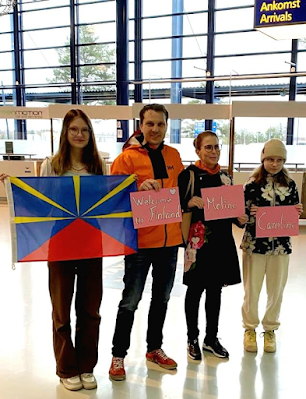
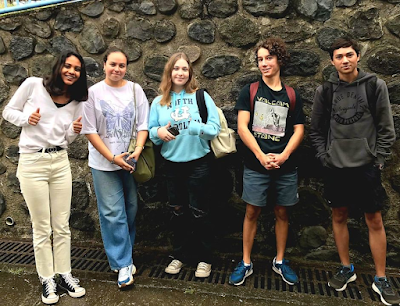
Laanila's (and Svenska Privatskolan's) Erasmus+ exchange program with Reunion continues in the fall of 2022 the following way:
Three Reunionese students to Laanila in October 15 - November 15, 2022
(Two Reunionese students to Svenska Privatskolan in October 15 - November 15, 2022)
Three Laanila students to Reunion in November 15 - December 15, 2022
(Two Svenska Privatskolan's students to Reunion in November 15 - December 15, 2022)
WATCH A VIDEO OF THE EXCHANGES IN 2021
WATCH A VIDEO OF THE EXCHANGES IN 2019
Laanila's (and Svenska Privatskolan's) exchange program with Reunion continues in the spring of 2023 the following way:
Three Laanila students to Reunion in April 4 - May 4, 2023
(Two Svenska Privatskolan's students to Reunion in April 4 - May 4, 2023)
Three Reunionese students to Laanila in May 4 - June 4 2023
(Two Reunionese students to Svenska Privatskolan in May 4 - June 4 2023)
THE PROCESS OF GOING ON A COST-FREE EXCHANGE
Responsible for the preparation and follow-up of the study
mobilities at Laanila: Contact teacher Tiina Fredriksson and Mentor teachers Jaana Kuikka & Antti Pekkala who will support the student mobilities in the best possible way and make necessary practical arrangements for the students, including
appropriate insurance cover and travel to the host country and back.
The selection of students is carried out by the sending school teachers who will conduct a thorough selection process to ensure that the students who go abroad have the necessary personal and academic competence to make a
success of the stay. Once the pupil is selected, the Health form, the placement annex to the Pupil application form and the Parental/Guardian consent form will be completed and signed.
Motivation will be a key factor in selection. First of all it is
important to ensure that the students have a good idea about what a mobility
period abroad implies. They need to know that being abroad and on their own for
a longish period of time is not always easy, and that they will probably go
through tough periods and encounter problems that they need to cope with on
their own.
Checking up on student motivation and commitment will be done by asking them to write a
motivation letter describing their expectations and reasons for applying.
Parents must be in full agreement with the project and willing to
give their full support to students while they are away. Parents who are
constantly worried and who transmit these worries to their children have a
disruptive influence on the stay, and may in the last instance push them to
drop out.
The student’s application will therefore include a statement from
the parents which makes it clear that they understand this and that they are
prepared to provide support and encouragement throughout the stay.
The student will be alone in a new world, and will need to make
friends and integrate into a new school community. Those who tend to avoid
challenges will not make the most of the experience and could face serious
difficulties during the stay. Having an open-minded personality is not
necessarily the same as being popular; sometimes popularity is due to factors
in the environment rather than in the personality itself.
A good indicator of an open-minded personality is involvement in
hobbies and leisure activities, where friendships are formed with people that
have a shared interest. This can be music, sports, chess or politics — anything
that is undertaken jointly with others.
Being away from family and friends for a long period of time is
not easy, and it may happen that students are overwhelmed by the situation and
return home after only a couple of days or weeks. Good preparation and support
can reduce the risk considerably, but students must also have sufficient mental
resources to cope with difficult periods on their own.
It is important to be aware of the fact that outspoken behaviour
does not necessarily indicate self-reliance, and that quiet and apparently
timid personalities may in fact possess great powers of adaptation and
endurance. The student selected should be self-confident and be able to face and
overcome obstacles.
Academic ability is an advantage for someone participating in a
long-term mobility project in an educational context. Not only will the student have to follow lessons in a system that is likely to be very different from
what he or she is used to (and in a foreign language of which the student may not
necessarily have any previous knowledge) — there may also be work to do in
catching up with the others after the return to the home country. For someone
who is already struggling in the home country, there is a risk that a prolonged
absence may worsen these problems.
Excellent marks are not a
condition for participation: it is the overall ability that counts, and not the
actual level of attainment at a specific moment in time. In fact, so called
‘underachievers’ can make perfect participants, and the experience may help
bring out their real competence. Teachers often know whether one of their students is performing according to his or her true potential or just putting in
a mediocre performance due to a temporary lack of motivation.
Once the pupil is selected, sending families need to provide all
personal information relating to the student which is relevant for a long stay
abroad (health, medication, psychological issues) and sign a Parental/Guardian
consent form indicating responsibilities of the student and his/her family.
- At the application stage, provide all necessary information which might be relevant for a long stay abroad (Pupil application form, Health form)
- Prepare for the stay abroad (linguistic preparation if necessary, participation in training events provided)
- Prepare and sign the learning agreement together with the sending and the receiving school
- Get to know possible risks and emergency procedures (Crisis management)
- Get to know the laws concerning minors in the host country and abide by them
- Sign the Parental/Guardian consent form and follow the rules of conduct established by the Parental/Guardian consent form and also those agreed by the two schools
- Know who to contact in a crisis (Crisis action plan)
- Not take unnecessary risks
- Behave responsibly
- Be sensitive to local codes and customs
- Give the sending and receiving schools and the mentor/contact teacher all necessary information about his/her health (i.e. any problem which could develop into an emergency during the stay). The Health form (Part 2) completed by the doctor should be put into a sealed envelope and the pupil should keep it during the whole stay.
- Contribute to the evaluation and final report of the mobility activity.
- At the application stage, provide all necessary information which might be relevant for a long stay abroad (Pupil application form, Health form)
- Get to know possible risks and emergency procedures (Crisis management)
- Get to know the laws concerning minors in the host country
- Sign the Parental/Guardian consent form
- Support the student throughout the mobility experience
- Communicate any relevant problem to the contact teacher at the sending school
Sending and receiving schools
establish a learning agreement together with the student before the start of the
mobility, detailing the courses and curriculum to be followed during the period
abroad and their planned outcomes. The aim of this agreement is to facilitate
the recognition by the sending school of the studies the student carries out
during the stay abroad. It is also possible to use Europass mobility
certificate.
The selection of host families is carried out by the receiving
school. It is recommended that the school visit the home of the
possible host families to ensure the suitability of the accommodation for the
incoming student. Receiving schools will ensure that each host family has signed
the Host Family Charter, stating its rights and responsibilities, before
receiving an incoming student.
The sending school makes sure that the students have the
necessary insurance coverage.
The receiving school establishes and
distributes a Crisis Action Plan that all actors are required to follow.
Rules of conduct
Agree with the
receiving school a set of clear rules
of conduct for the student in addition to those covered by the Parental/Guardian consent form,
including possible consequences if they break the rules.